
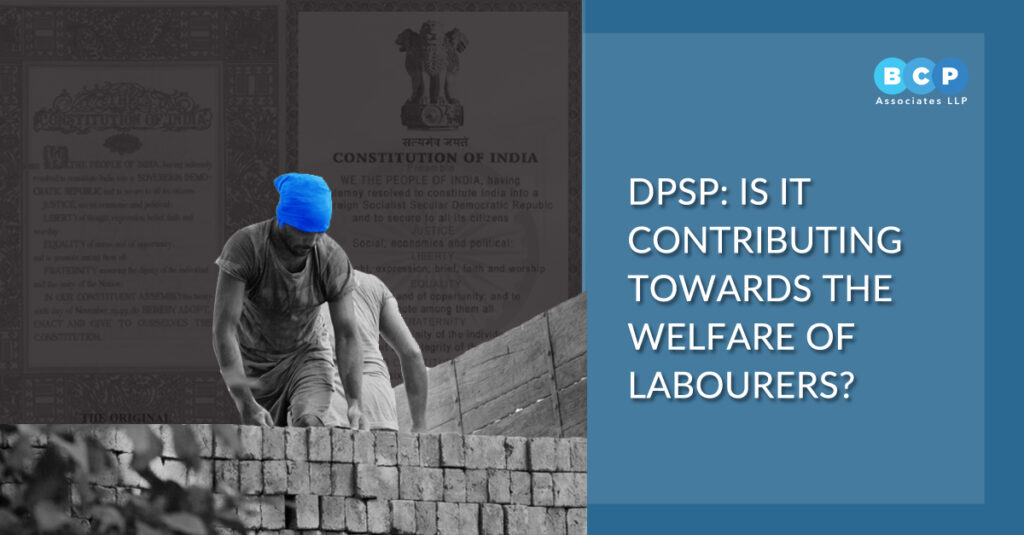
DPSP: Is It Contributing Towards The Welfare Of Labourers?

Labour & Employment, Dispute Resolution Manufacturing, GCC
March 19, 2022
Sneha Muralidharan Advocate & Junior Associate

The framers of the Constitution have included a few Articles targeting to enhance the socio-economic status of workers. The Directive Principles of State Policy (‘DPSP’) was therefore introduced to promote the prosperity and well-being of the people. These are state principles that call for constructive action and directives to legislators and the administration to secure and develop the socio-economic wellbeing of the public. The actual idea of the constitution is brought to life through Directive Principles of State Policy and the Fundamental Rights. The idea of the welfare of the workers is also pointed out in the Preamble as “Justice, social, economic and political”. The importance of preserving and defending the dignity of human labour has been codified in Chapter III of the Constitution dealing with Fundamental Rights (Articles 16, 19, 23 and 24) and Chapter IV dealing with Directive Principles of State Policy (Articles 39, 41, 42, 43, 43A and 54).

Articles 42 and 43 show deep concerns for the welfare of the workers, wherein, Article 42 states “The State shall make provision for securing just and humane conditions of work and for maternity relief.” And Article 43 states “The State shall endeavour to secure, by suitable legislation or economic organization or in any other way, to all workers, agricultural, industrial or otherwise, work, a living wage, conditions of work ensuring a decent standard of life and full enjoyment of leisure and social and cultural opportunities and, in particular, the State shall endeavour to promote cottage industries on an individual or co-operative basis in rural areas.”

Even if the courts are unable to implement the Direct Principles of State Policies, they must interpret them to protect workers’ welfare. In many cases, Article 42 serves as the foundation for a plethora of labour laws. For example, in the case of Municipal Corporation of Delhi V. Female Workers (muster roll)[1], maternity leave was granted to regular female workers, but not to muster roll female workers because their service had not been regularized. As a result, they were not eligible for such leave. Hence, the honourable Supreme Court invoked Article 42 and the concept of social justice conceded the demand of these female workers for maternity leave.

Mirroring the judgment, the Maternity Benefit Act, 1961 has aimed to ensure that women employees including birth mothers, commissioning and adoptive mothers have been provided with maternity benefits. The Maternity Benefit Act is also extended to cases of miscarriage, termination of pregnancy, tubectomy, etc.

Similarly, Article 43 is founded on the revolutionary idea that employees are entitled to certain benefits as a matter of right including, significantly, minimum wage. In Article 43, the term “Living Wage” plays a significant part. The “Living Wage” is not the same as the “Minimum Wage.” The minimum wage is adequate to meet a worker’s and his family’s basic physical necessities, whereas living wages or fair wages must be determined in light of the industry’s ability to pay. In addition to the essential needs of life, such as food, shelter, and clothes, the notion of a living wage includes provisions for children’s education and insurance, as well as various leisure activities and social and cultural upliftment. Thus, in the case of All India Reserve Bank Employees V. Reserve Bank[2], the honourable Supreme Court held that the political aim is Living Wages for workers.

Thus, the payment of the statutory minimum bonus even when the management suffers a loss is one of the best instances of enabling the Living Wages. Likewise, the pension programme not only compensates service performed in the past of the worker, but it also serves as a social welfare mechanism to ensure social justice by giving financial stability in later life when one is forced to rely on savings. The same was held in the case of D.V. Kapoor V. Union of India[3] by the honourable Supreme Court. Also, in the landmark judgment of Vishaka v. State of Rajasthan[4], the court went through a similar process, using Articles 21 and 42, and establishing standards for legally solving the problems of sexual harassment of women at work.

Thus, in the wake of the Vishaka judgment, the Sexual Harassment of Women at Workplace (Prevention, Prohibition and Redressal) Act, 2013 was passed highlighting the welfare provisions like setting up of the Internal Complaints Committee for redressal of complaints of sexual harassment in a confidential and speedy manner.

Further, by The Constitution (Forty-second amendment) Act, 1976, Article 43A was inserted where the State was required to ensure the participation of employees in the management of undertakings, establishments or other organizations engaged in any industry. It was a notable step towards the welfare of the employees, and it helped the employees to express their demands to the management. Similarly, invoking Article 43A of the Constitution of India, Section 9-C of the Industrial Disputes Act, 1947 was inserted in the year 1982 where every industrial establishment with twenty or more workers must have one or more grievance redressal committees (GRC) made up of representatives of management and workers in an equal proportion. This GRC would deal with the individual grievances against company rules and procedures, the nature of work, co-workers or company authorities, and payment issues.

Though the Directive Principles of State Policies have influenced labour laws and the emerging labour laws have ensured that employees have a decent standard of living, it must be noted that these benefits are not available to those in the unorganized sector. As things stand, therefore, the unorganized sector is not able to take advantage of the benefits guaranteed to them.

[1] Municipal Corporation of Delhi V. Female Workers (muster roll) AIR 2000 SC 1274.
[2] All India Reserve Bank Employees V. Reserve Bank AIR 1966 SC 305.
[3] D.V. Kapoor V. Union of India 1990 AIR 1923.
[4] Vishaka v. State of Rajasthan (1997) 6 SCC 241.
Share:

Disclaimer

In compliance with the rules of the Bar Council of India, this website , www.bcpassociates.com, of BCP Associates LLP (the “Firm”) is meant solely for information about the Firm, its practice areas, and advocates and not for the purpose of advertising, soliciting work or inducement of any sort by the Firm or any of its members. Nor is it to be construed as legal advice of any nature or manner whatsoever. You acknowledge and confirm that you are seeking information relating to the Firm of your own accord and that there has been no form of solicitation, advertisement or inducement by the Firm or its members.
 
The content of this website is also the Intellectual Property of the Firm.
 
We use cookies to enhance your experience. By continuing to visit this website you agree to our use of cookies.
 
By clicking on ‘I AGREE’ below, the you acknowledge that the information provided is meant only for your understanding of the Firm and its activities.
 
Please read and accept our website’s Terms of Use and our Privacy Policy

Ongoing Advisory for a GCC of a Motor Vehicle Components Manufacturer

Advisory, Corporate, DPDP GCC

The Context

A Global Capability Centre (GCC) of a leading motor vehicle components manufacturer engaged the Firm on a retainer basis for ongoing advisory on labour and employment matters, requiring consistent legal support across workforce policies and operational issues.

The Approach

We provided continuous, practical legal guidance across a range of workplace matters. Our approach included:

  • Advising on employment bonds, leave policies, and staffing arrangements
  • Reviewing and strengthening internal policies and frameworks
  • Guiding on workplace facilities, including canteen-related requirements
  • Supporting disciplinary and misconduct-related matters

The Outcome

The engagement enabled the client to:

  • Strengthen policy frameworks and workforce governance
  • Ensure alignment with applicable labour law requirements
  • Address workplace issues with clarity and consistency
  • Build a compliant and structured HR environment

Key Takeaways

1

Continuous Advisory Support

Ongoing engagement ensures consistency in handling workforce matters.

2

Policy-Led Governance

Well-defined policies strengthen organisational clarity and compliance.

3

Practical Legal Guidance

Business-aligned advice supports effective decision-making.

4

Proactive Issue Management

Early intervention helps mitigate risks in workplace matters.

Provident Fund Challenge for a Clothing Manufacturer

Advisory, Disputes Textile, Manufacturing

The Context

A major clothing manufacturer received notices alleging non-payment of contributions under the Employees’ Provident Funds and Miscellaneous Provisions Act, 1952. The situation escalated with the attachment of the company’s primary bank account, creating immediate operational and financial challenges.

The Approach

We advised and represented the client in challenging the government’s actions before the High Court of Karnataka. Our approach included:

  • Assessing the validity of the notices and enforcement actions
  • Formulating a legal strategy to challenge the attachment and proceedings
  • Representing the client before the High Court
  • Seeking urgent interim relief to protect business operations

The Outcome

The client secured immediate relief with:

  • Stay of the proceedings granted by the High Court
  • Restoration of operational continuity by addressing account attachment concerns
  • Strengthened legal position pending final adjudication


The matter is currently pending before the High Court of Karnataka.

Key Takeaways

1

Immediate Legal Intervention

Timely action is critical in matters involving coercive recovery measures.

2

Protecting Business Continuity

Securing interim relief helps minimise operational disruption.

3

Statutory Challenge Strategy

Careful evaluation of enforcement actions strengthens defence.

4

Litigation Preparedness

Strong representation ensures effective handling of ongoing proceedings.

POSH Appeal Defence for a Multinational Technology Company

POSH Manufacturing, IT

The Context

A multinational computer hardware manufacturer faced an appeal under the POSH Act following an Internal Committee finding that dismissed allegations of sexual harassment. The appeal raised multiple procedural and substantive challenges, further complicated by the time gap between the original inquiry and the appellate proceedings.

The Approach

We advised and represented the client through the appellate process with a structured legal strategy. Our approach included:

  • Reviewing the Internal Committee findings and procedural compliance
  • Reconstructing facts and documentation for an older matter
  • Advising on responses to allegations on both procedural and substantive grounds
  • Representing the client before the statutory appellate authority

The Outcome

The client successfully defended the appeal with:

  • Affirmation of the Internal Committee’s findings
  • Dismissal of the appellant’s claims
  • Strengthened legal position and procedural defensibility
  • Closure of a complex and sensitive matter

Key Takeaways

1

Importance of Procedural Integrity

Strong adherence to POSH processes supports defensibility at the appellate stage.

2

Managing Legacy Cases

Reconstructing facts in older matters requires structured documentation and strategy.

3

Effective Appellate Representation

Clear legal positioning across procedure and merits drives favourable outcomes.

4

Sensitivity in Workplace Matters

Balanced handling ensures fairness while protecting organisational interests.

Labour Law Audit for an Engine Manufacturer

Audit Automobile, Manufacturing

The Context

A large engine manufacturer commissioned a one-time labour law audit across its manufacturing units to assess compliance with statutory requirements and identify operational risks. The review revealed significant gaps, particularly around working hours and mandatory rest periods for both direct and contract workers.

The Approach

We conducted a detailed audit focused on statutory compliance and workforce practices. Our approach included:

  • Reviewing working hours, overtime, and rest period practices
  • Assessing compliance across direct employees and contract workforce
  • Identifying deviations from statutory requirements
  • Recommending corrective actions to address non-compliances

The Outcome

The client was able to:

  • Identify and address critical compliance gaps
  • Align working hours and rest periods with statutory requirements
  • Implement corrective measures for overtime and holiday payments
  • Strengthen compliance and reduce regulatory exposure

Key Takeaways

1

Workforce Practices Require Regular Review

Audits help uncover systemic gaps in working conditions.

2

Statutory Compliance is Critical

Adherence to working hours and rest periods is essential for legal and operational stability.

3

Clear Corrective Actions Matter

Actionable recommendations enable timely remediation.

4

Proactive Risk Management

Early intervention reduces legal and financial exposure.

Defamation Action for a Pharmaceutical Client

Advisory, Corporate, Disputes Pharmaceuticals

The Context

A large pharmaceutical company faced reputational challenges when a senior employee made false allegations against senior management and published defamatory content across multiple social media platforms. Despite internal investigations disproving the claims, the posts continued, escalating the issue.

The Approach

We advised and represented the client through a structured legal response. Our approach included:

  • Assessing the allegations and legal implications of the defamatory content
  • Issuing cease and desist notices to the individuals involved
  • Engaging with social media platforms for removal of offending content
  • Developing a strategy to protect the client’s reputation and legal position

The Outcome

The client successfully addressed the situation with:

  • Removal of defamatory content from social media platforms
  • Cessation of further allegations by the individuals involved
  • Protection of organisational reputation and leadership credibility
  • Effective resolution without prolonged litigation

Key Takeaways

1

Reputation Risk Management

Timely legal action is critical in addressing reputational threats.

2

Multi-Channel Response

Handling defamation requires coordinated action across legal and digital platforms.

3

Strategic Escalation

Progressive steps-from notices to enforcement-enable controlled resolution.

4

Protecting Leadership Integrity

Swift response helps safeguard organisational trust and credibility.

Comprehensive Labour & Environmental Compliance Audit

Audit Automobile, Manufacturing

The Context

A global manufacturing network with multiple factories and subsidiaries across India required a comprehensive audit of its labour and environmental compliance practices. The engagement involved assessing statutory adherence, workplace safety, and governance across operations and vendor ecosystems.

The Approach

We conducted an extensive, multi-layered audit combining on-ground assessments with detailed analysis. Our approach included:

  • Stakeholder consultations and on-site verification of statutory records and registers
  • Review of compliance with key labour laws, including the Factories Act, and environmental regulations
  • Evaluation of health, safety, and environmental practices across units
  • Assessment of vendor management systems and supply chain governance
  • Worker interactions and walkthroughs to assess real-world implementation

The Outcome

The engagement enabled the client to:

  • Identify compliance gaps with clear, actionable recommendations
  • Establish a standardised and future-ready compliance framework
  • Enhance transparency across operations and vendor networks
  • Significantly reduce legal and operational risks
  • Strengthen workplace safety and sustainable practices

Key Takeaways

1

Holistic Compliance Assessment

Comprehensive audits must cover operations, workforce, and vendor ecosystems.

2

Ground-Level Validation

On-site verification and worker interactions provide critical practical insights.

3

Actionable Recommendations

Clear, tailored inputs enable effective corrective measures.

4

Sustainable Compliance Frameworks

Standardisation improves long-term governance and operational resilience.

Advisory on Closure of Manufacturing Facility

Disputes, Advisory, Corporate Manufacturing, FMCG

The Context

A large food manufacturing company undertook the closure of one of its factories in Bengaluru. The matter involved navigating complex labour law requirements, obtaining statutory approvals, and addressing workforce challenges, including employee strikes and union resistance.

The Approach

We provided end-to-end legal advisory and representation throughout the closure process. Our approach included:

  • Structuring a legally compliant closure process aligned with statutory requirements
  • Guiding the client through documentation and approval procedures
  • Representing the client before authorities and courts in union-led challenges
  • Advising on employee compensation and statutory benefits
  • Supporting the client in managing industrial actions in accordance with law

The Outcome

The client successfully executed the closure with:

  • Approval granted by the Specified Authority for closure
  • Successful defence against union challenges before the High Court (Single Judge and Division Bench)
  • Resolution of employee-related issues, including strikes
  • A structured and compliant framework for employee separation and benefits

Key Takeaways

1

Regulatory Approval is Critical

Closure of manufacturing units requires strict adherence to statutory processes.

2

Managing Industrial Action

Effective legal strategy is essential to navigate strikes and union challenges.

3

Strong Litigation Support

Representation across forums ensures protection of business decisions.

4

Balanced Workforce Transition

Clear guidance on compensation and benefits enables smoother employee separation.

Large-Scale Investigation into Employee Fraud

Investigations GCC, BFSI

The Context

A multinational financial institution faced allegations of widespread financial misconduct involving a large number of employees. The scale and urgency of the matter required a structured, coordinated investigation process to address risks and enable timely action.

The Approach

We led the investigation through a team of experienced advocates, managing the process end-to-end. Our approach included:

  • Conducting investigations across a large pool of employees
  • Coordinating with multiple departments for access to documents and stakeholders
  • Structuring schedules and processes to handle scale efficiently
  • Preparing detailed investigation reports within defined timelines
  • Advising on appropriate disciplinary actions based on findings

The Outcome

The client successfully addressed the matter with:

  • Timely completion of investigations across several hundred employees
  • Clear identification of misconduct and responsible individuals
  • Implementation of appropriate disciplinary actions
  • Controlled risk exposure and preservation of organisational integrity

Key Takeaways

1

Managing Scale in Investigations

Structured processes are critical when handling large volumes of cases.

2

Cross-Functional Coordination

Effective collaboration ensures timely and accurate outcomes.

3

Timely Action Matters

Swift investigation and response help mitigate financial and reputational risks.

4

Defensible Outcomes

Well-documented findings support strong disciplinary decisions.

POSH Inquiry Involving Senior Leadership

POSH Garments, Manufacturing

The Context

A large clothing manufacturer faced complaints of sexual harassment against a senior executive, raised by two employees. The matter was sensitive, involving serious allegations and concerns of retaliation, requiring a careful, compliant, and confidential approach under the POSH Act.

The Approach

An External Member from the Firm was part of the Internal Committee constituted under the POSH Act. We provided end-to-end advisory throughout the inquiry process. Our approach included:

  • Guiding the Internal Committee on procedural compliance and fair inquiry processes
  • Advising on interim measures to safeguard the complainants
  • Ensuring confidentiality and protection against retaliation
  • Recommending appropriate disciplinary actions based on findings

The Outcome

The matter was successfully concluded with:

  • A fair and legally compliant inquiry process
  • Substantiation of complaints based on thorough evaluation
  • Appropriate disciplinary action against the respondent
  • Restoration of employee confidence and trust in the organisation

Key Takeaways

1

Sensitivity & Confidentiality

Handling such matters requires a balanced and discreet approach.

2

Procedural Integrity

Strict adherence to POSH processes ensures fairness and defensibility.

3

Workplace Safety Focus

Timely interim measures are critical to protect complainants.

4

Organisational Impact

Decisive action reinforces trust and fosters a safe working environment.

Challenge to International Worker Provisions under EPF Scheme

Disputes Education

The Context

The client challenged provisions under the Employees’ Provident Fund Scheme and Pension Scheme that required higher provident fund contributions for international workers compared to domestic employees. This created an unequal framework and imposed a significant financial burden on employers, while also impacting take-home pay for international workers.

The Approach

We represented the client in challenging the validity of these provisions before the High Court of Karnataka. Our approach included:

  • Developing a constitutional and statutory challenge to the differential treatment
  • Arguing against the lack of a rational basis for higher contribution requirements
  • Highlighting the financial and operational impact on employers and employees
  • Presenting a structured legal strategy focused on equity and regulatory consistency

The Outcome

The High Court of Karnataka struck down the relevant provisions, resulting in:

  • Removal of differential treatment between international and domestic workers
  • Reduction in employer liability by aligning contributions with standard wage limits
  • Improved take-home pay for international workers
  • A significant precedent impacting labour law compliance for employers


The judgment has been challenged by the EPFO; however, as of March 2026, the appeal is pending with no stay on the original order.

Key Takeaways

1

Constitutional Validity Matters

Differential treatment must have a clear legal and rational basis.

2

Financial Impact of Regulation

Regulatory provisions can significantly affect employer costs and workforce compensation.

3

Strategic Litigation

Well-structured challenges can reshape regulatory frameworks.

4

Precedent-Setting Outcome

Judicial decisions can have wide-ranging implications across industries.

Advisory & Representation for a Public Sector Bank

Disputes Banking

The Context

A leading public sector bank engaged the Firm for advisory and representation in multiple labour and employment law matters. The engagement involved complex litigation, including issues relating to statutory liabilities under the Employees’ Provident Funds and Miscellaneous Provisions Act.

The Approach

We provided strategic legal support across advisory and litigation matters. Our approach included:

  • Representing the client before the Central Government Industrial Tribunal and the High Court of Karnataka Advising on statutory obligations, including matters under the EPF Act Developing consistent legal strategies across multiple proceedings Supporting the client through complex and high-stakes labour disputes
  • Evaluating existing practices against the new legal framework
  • Advising on alignment with union settlements and operational realities
  • Supporting a structured transition from legacy laws to the new regime

The Outcome

The engagement enabled the client to:

  • Effectively manage and defend complex litigation matters
  • Ensure alignment with statutory requirements and legal obligations
  • Strengthen its legal position across forums
  • Navigate regulatory and workforce-related challenges with confidence

Key Takeaways

1

Multi-Forum Representation

Effective handling across tribunals and courts ensures consistency in legal strategy.

2

Statutory Expertise

Deep understanding of labour laws is critical in managing regulatory liabilities.

3

Strategic Litigation Approach

Coordinated advisory strengthens outcomes in complex disputes.

4

Trusted Legal Partnership

Ongoing support enables proactive management of legal risks.

Advisory on Organisational Restructuring for an IT Services Provider

Advisory, Corporate, DPDP IT

The Context

An Indian IT services provider engaged the Firm for long-term advisory on structuring its organisation to align with its business model, improve operational efficiency, and meet labour law requirements. The engagement evolved to include restructuring of operations and subsequent merger-related integration.

The Approach

We provided ongoing strategic and legal support across multiple phases of the engagement. Our approach included:

  • Advising on organisational structuring aligned with business and operational needs
  • Ensuring alignment with applicable labour and employment laws
  • Supporting restructuring of operations to enhance efficiency
  • Guiding the client through merger processes and integration of workforce structures

The Outcome

The client successfully achieved:

  • An optimised organisational structure aligned with its business objectives
  • Smooth execution of restructuring initiatives
  • Seamless integration during merger with another organisation
  • Sustained compliance and operational efficiency across evolving business needs

Key Takeaways

1

Long-Term Strategic Advisory

Continuous engagement enables alignment with evolving business requirements.

2

Business-Aligned Structuring

Legal frameworks must support operational efficiency and scalability.

3

Seamless Transition Management

Structured approach ensures smooth restructuring and integration.

4

Integrated Legal & Operational Insight

Combining legal expertise with business understanding drives effective outcomes.

Ongoing Advisory for a Multinational Motor Vehicle Manufacturing Group

Advisory, Corporate, DPDP Automobile, Manufacturing

The Context

A multinational motor vehicle manufacturing group engaged the Firm for ongoing advisory on labour and employment matters across its operations. The engagement involved complex workforce issues, including union negotiations, wage settlements, and integration challenges arising from mergers.

The Approach

We provided continuous legal and strategic support across a wide range of matters. Our approach included:

  • Advising on union-related matters and wage settlements
  • Guidance on terminal benefits and social security obligations
  • Supporting disciplinary and misconduct-related issues
  • Advising on employee integration during mergers and organisational changes

The Outcome

The long-standing engagement enabled the client to:

  • Navigate complex labour and workforce challenges effectively
  • Maintain stability in industrial relations across operations
  • Ensure alignment with statutory requirements and organisational goals
  • Successfully manage workforce transitions during structural changes

Key Takeaways

1

Long-Term Advisory Value

Sustained engagement enables consistent and strategic decision-making.

2

Industrial Relations Expertise

Effective handling of unions and settlements is key to operational stability.

3

Workforce Transition Management

Careful planning ensures smooth integration during mergers.

4

Holistic Legal Support

Integrated advisory across multiple areas strengthens overall workforce governance.

Ongoing Advisory for a Multinational Software Company

Advisory

The Context

A leading India-based multinational software company engaged the Firm for ongoing advisory and representation on a wide range of labour and employment matters. The engagement spans complex workforce issues, regulatory requirements, and evolving legal frameworks.

The Approach

We provided continuous, strategic support across advisory and litigation matters. Our approach included:

  • Advising on union-related matters and workforce dynamics
  • Guidance on contract labour, social security, and Labour Codes
  • Supporting clients on misconduct, disciplinary actions, and workplace issues
  • Handling litigation and regulatory matters with a consistent legal strategy

The Outcome

The long-standing engagement has enabled the client to:

  • Navigate complex labour and employment challenges with confidence
  • Ensure alignment with evolving legal and regulatory requirements
  • Effectively manage disputes and workforce-related risks
  • Build a stable and compliant workforce framework

Key Takeaways

1

Continuous Legal Partnership

Ongoing advisory ensures consistency and proactive issue resolution.

2

Multi-Dimensional Expertise

Handling advisory and litigation together strengthens overall outcomes.

3

Adaptability to Evolving Laws

Regular guidance supports compliance with changing regulatory frameworks.

4

Long-Term Value Creation

Sustained engagement builds trust and strengthens organisational resilience.

Annual Labour Law Compliance Audits for an Automobile Manufacturer

Audit Automobile, Manufacturing

The Context

A leading automobile manufacturer engaged the Firm to conduct recurring annual labour law compliance audits at its large-scale manufacturing facility in Karnataka. The audits required detailed on-ground assessments of operations, contractor practices, and adherence to statutory obligations under key labour laws.

The Approach

We conducted comprehensive, technology-enabled audits combining physical inspections with structured analysis. Our approach included:

  • On-ground review of factory operations and workforce practices
  • Detailed assessment of contractor and vendor compliance
  • Verification of licences, registrations, and statutory records
  • Use of in-house audit software to generate structured audit reports

The Outcome

The client benefited from a robust and evolving compliance framework with:

  • Identification and mitigation of legal and operational risks
  • Enhanced transparency in labour practices across operations
  • Improved readiness for regulatory inspections and changes
  • Strengthened alignment with best practices in worker welfare and governance

Key Takeaways

1

Proactive Compliance Approach

Regular audits help identify gaps early and reduce long-term risks.

2

Technology-Enabled Processes

Digital audit tools enhance accuracy, consistency, and reporting.

3

End-to-End Visibility

Comprehensive reviews across contractors and operations ensure holistic compliance.

4

Sustainable Compliance Framework

Ongoing audits build a strong foundation for regulatory readiness and organisational growth.

Advisory on Labour Codes for a Public Sector Enterprise

Labour Codes, Advisory Defence, Manufacturing

The Context

The client, a leading public sector defence manufacturer with operations across multiple locations in India, undertook the transition to the new Labour Codes. The complexity was heightened by varying state-specific requirements and existing union settlements across different units.

The Approach

We provided comprehensive advisory on implementing the Labour Codes across the client’s nationwide operations. Our approach included:

  • Assessing applicability across multiple offices and manufacturing units
  • Evaluating existing practices against the new legal framework
  • Advising on alignment with union settlements and operational realities
  • Supporting a structured transition from legacy laws to the new regime

The Outcome

The client successfully transitioned to the new framework with:

  • Consistent implementation across all locations
  • Alignment with statutory requirements and existing agreements
  • Minimal disruption to operations and workforce management
  • A clear, standardised compliance framework for future operations

Key Takeaways

1

Multi-Location Complexity

Large-scale operations require tailored strategies across jurisdictions.

2

Integration with Existing Agreements

Alignment with union settlements is critical for smooth implementation.

3

Structured Transition Approach

Phased and well-planned execution ensures operational continuity.

4

Consistent Compliance Framework

Standardisation across units strengthens long-term governance.

Defence in Employee Termination Proceedings

Disputes, Advisory Manufacturing, Aerospace

The Context

The client faced a civil suit filed by an employee seeking an injunction against termination following disciplinary proceedings, along with claims for damages. Parallel proceedings were also initiated before the Labour Department seeking reinstatement and related reliefs, creating a multi-forum legal challenge.

The Approach

We advised the client on a coordinated legal strategy across all proceedings. Our approach included:

  • Developing a consistent defence strategy across civil and labour forums
  • Advising on positioning and responses in disciplinary and legal proceedings
  • Managing parallel litigation to ensure alignment and minimise risk
  • Providing ongoing strategic guidance at each stage of the matter

The Outcome

The matter was successfully resolved with:

  • Dismissal of claims through effective defence strategy
  • Withdrawal of the civil suit by the employee
  • No adverse impact on the client’s position
  • Strengthened legal standing across related proceedings

Key Takeaways

1

Multi-Forum Strategy

Coordinated approach across civil and labour proceedings is critical for consistency.

2

Strong Defence Positioning

Clear legal strategy helps mitigate risks in employment disputes.

3

Effective Litigation Management

Handling parallel proceedings ensures controlled and aligned outcomes.

4

Strategic Resolution

Well-planned defence can lead to early and favourable closure of disputes.

Restructuring of Group Operations in India

Corporate, Advisory GCC, ITES

The Context

The client undertook a restructuring of its group operations in India, involving the transfer of employees across multiple entities within the organisation. The process required careful evaluation of legal feasibility across different employee categories, along with alignment to employment contracts and statutory requirements.

The Approach

We advised the client on the end-to-end employee transfer process as part of the restructuring exercise. Our approach included:

  • Assessing feasibility of transferring employees across various grades
  • Reviewing employment contracts and applicable legal provisions
  • Structuring the transfer process in compliance with regulatory requirements
  • Providing step-by-step guidance along with required documentation

The Outcome

The client successfully implemented the restructuring with:

  • Seamless transfer of employees across group entities
  • Full alignment with contractual and legal requirements
  • Minimal operational disruption during the transition
  • A structured and compliant framework for future organisational changes

Key Takeaways

1

Legal Feasibility Assessment

Evaluating employee categories and contractual terms is critical for smooth transfers.

2

Structured Implementation

A step-by-step approach ensures clarity and reduces execution risks.

3

Compliance-Led Strategy

Alignment with legal requirements is essential for sustainable restructuring.

4

Documentation & Process Clarity

Well-prepared documentation supports seamless execution and future scalability.

Closure of Pharma Manufacturing Facility

Advisory, Corporate and Commercial Pharmaceuticals

The Context

Our client, a leading pharmaceutical manufacturer, undertook the closure of a manufacturing facility in Bengaluru. The situation was complex, as the closure coincided with ongoing wage negotiations with the workers’ union, creating potential risks of industrial unrest and operational disruption.

The Approach

We provided end-to-end advisory throughout the closure process, guiding the client at every stage. Our approach included:

  • Strategic guidance on the legal and procedural aspects of closure
  • Advisory on structuring a voluntary retirement scheme (VRS)
  • Support in navigating ongoing wage negotiations with the union
  • Ensuring alignment with statutory requirements and workforce considerations

The Outcome

The client successfully executed the closure with:

  • A smooth and structured transition process
  • No industrial action or disruption from employees
  • Mutually agreeable separation terms for the workforce
  • Preservation of organisational reputation and stakeholder confidence

Key Takeaways

1

Strategic Workforce Planning

Careful planning is critical when closure overlaps with union negotiations.

2

Balanced Negotiation Approach

Well-structured VRS and negotiation strategies help achieve amicable outcomes.

3

Risk Mitigation

Proactive legal guidance minimises the risk of industrial unrest.

4

Dignified Separation

A structured and empathetic approach ensures fair outcomes for all stakeholders.

Labour Codes Transition Advisory for Multiple Organisations

Labour Code Services

The Context

The Government of India consolidated 29 labour legislations into four Labour Codes, operational from November 2025. These reforms significantly impact the entire employment lifecycle, requiring organisations to realign wage structures and policies to avoid financial and regulatory exposure.

The Approach

We supported organisations across India in navigating this transition, while also contributing to the drafting of Rules under the Labour Codes with the Government of Karnataka. Our approach included:

  • Assessing wage structures and HR policies against new legal requirements
  • Identifying gaps and areas requiring restructuring
  • Advising on policy and wage alignment with minimal financial impact
  • Supporting implementation across organisations of varying scale

The Outcome

We have successfully advised over 70 organisations, ranging from 60 to 50,000+ employees, resulting in:

  • Alignment with the new Labour Codes framework
  • Optimised wage structures and policies
  • Reduced financial exposure through strategic restructuring
  • Improved readiness for regulatory implementation and scrutiny

Key Takeaways

1

Wide-Ranging Regulatory Impact

The Labour Codes affect all aspects of the employment lifecycle.

2

Strategic Cost Optimisation

Proactive restructuring helps manage financial implications effectively.

3

Scalable Implementation

Solutions must adapt to organisations of different sizes and complexities.

4

Expertise-Driven Advisory

Deep understanding of legacy laws and new frameworks enables clear, outcome-focused solutions.